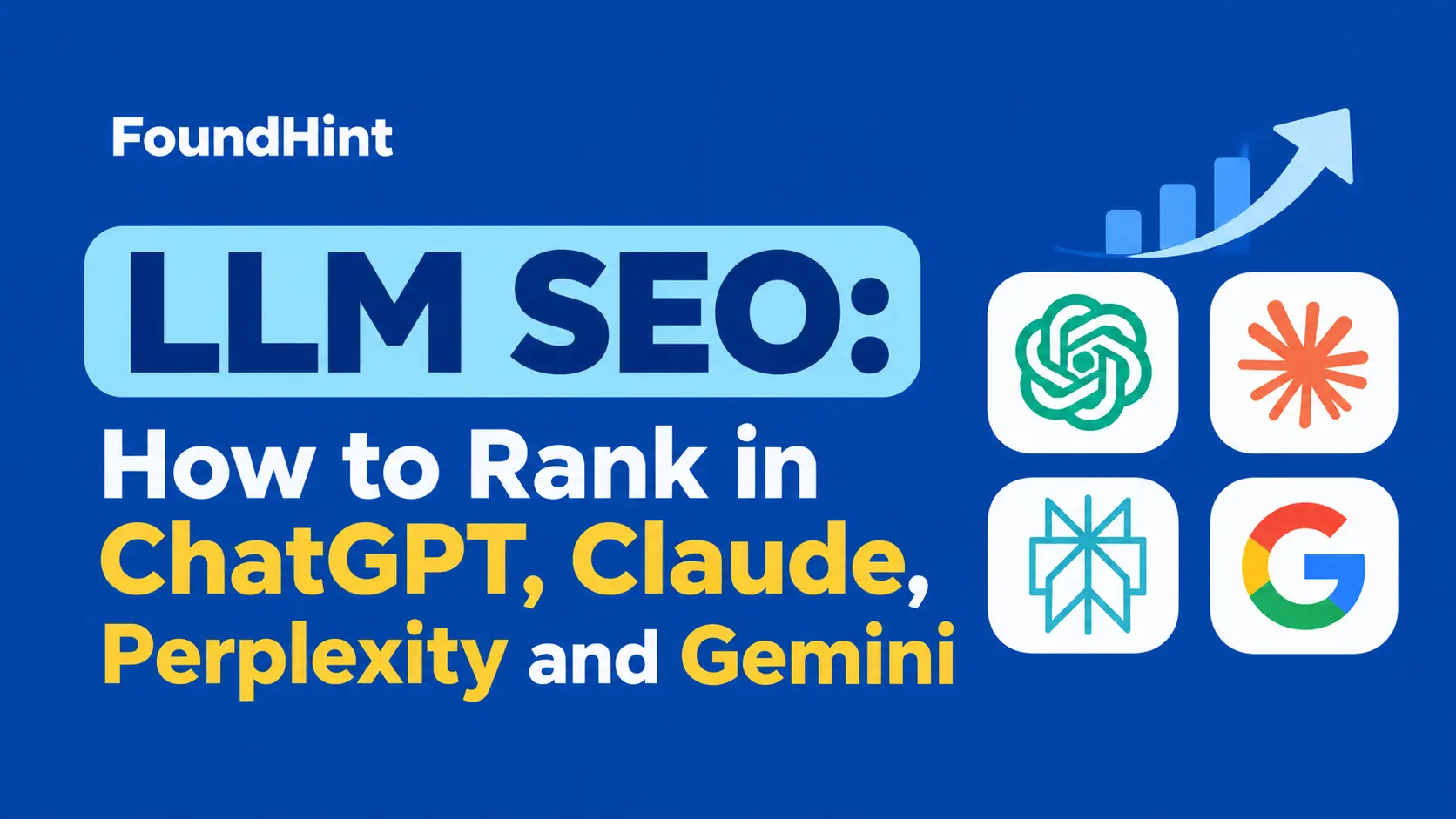
LLM SEO means optimizing your content so AI assistants like ChatGPT, Claude, Perplexity and Gemini mention and cite your site.
Make sure their crawlers can access your pages, rank well in traditional search (which many assistants draw on), write clear answer-first content with facts and original insight, use structured data, keep your business details consistent across the web, and earn mentions on sites AI tools already trust.
A potential customer asks ChatGPT, “What’s the best way to add local schema to WordPress?” or “Who’s a reliable roofer in Leeds?” The answer names three businesses and links two sources.
If yours isn’t among them, you never knew the conversation happened.
That’s the new search behavior LLM SEO is about: making your site and business the kind of source AI assistants find, trust and cite.
The good news is that it isn’t a separate discipline you have to learn from scratch.
Most of it is strong SEO, done with a few extra considerations about how language models read and retrieve content.
This guide explains how AI assistants choose sources, then gives eight practical tactics for a WordPress site.
 FoundHint Local SEO WordPress
Optimize your Google Business Profile without leaving WordPress
Connect your GBP profile, compare it with your website and fix the gaps FoundHint finds.
- Business Profile audit and optimization
- Google Post scheduling
- Review management and replies
- Local rank tracking on a map grid
How AI Assistants Choose What to Cite
AI assistants draw on two kinds of knowledge:
- Training data: what the model learned from a large snapshot of the web. Brands and facts that appear often and consistently across many trusted sources are more likely to be “known”.
- Live retrieval: when an assistant searches the web to answer a question, it fetches pages through a search index (its own, or a partner’s such as Bing or Google), reads them, and cites the ones it uses.
You influence the first slowly, by being mentioned widely and consistently. You influence the second much like traditional SEO: be crawlable, rank for the question, and make your answer easy to extract.
8 Tactics to Get Cited by AI Assistants
1. Let AI crawlers access your site
Check yoursite.com/robots.txt.
Some security plugins, CDNs and hosts block AI crawlers by default.
Common user agents include OpenAI’s OAI-SearchBot and GPTBot, Anthropic’s ClaudeBot, and PerplexityBot; Microsoft Copilot relies on Bingbot.
Search crawlers (the ones that fetch pages to answer live questions) are what matter most for being cited. Training crawlers are a separate decision about whether your content is used to train models.
In Cloudflare, also check Security > Bots settings, which can block AI crawlers at the network level regardless of robots.txt. Crawler names change, so confirm each provider’s current documentation.
2. Rank in traditional search
Many assistants retrieve pages through a search engine before answering. Pages that rank in Google and Bing for a question are far more likely to be read and cited.
Everything else on this blog still applies: technical health, relevance, internal links and authority. Make sure you’re verified in Bing Webmaster Tools too, since Bing’s index powers several AI products.
3. Write answer-first content
Put a direct, self-contained answer in the first two or three sentences under each heading, then expand. Use the question as the heading when it fits. AI tools extract passages, not pages, so each section should make sense on its own.
4. Include specific, checkable facts
Numbers, steps, prices, dates, comparisons and named examples give a model something concrete to cite. Vague, generic paragraphs are what models already know, so they have no reason to reference you.
5. Publish something only you have
Original data, case studies, survey results, pricing breakdowns, first-hand testing and expert opinion. Being the original source of a fact is the most reliable way to get cited for it.
6. Use structured data and clean HTML
Organization or LocalBusiness schema, Article schema with clear authors and dates, Product schema with prices, and clear HTML headings, lists and tables all reduce ambiguity. Avoid putting key content inside images, tabs that load via JavaScript only, or PDFs.
7. Be consistent across the web
Models form a picture of your business from many sources: your site, Google Business Profile, directories, social profiles, review sites and press.
If your name, description, services and details match everywhere, the picture is clear. If they conflict, the model may repeat the wrong version, or none.
8. Earn mentions where AI looks
Get listed and discussed on sites assistants already rely on: respected industry directories and associations, local news, “best of” roundups, Reddit and forum discussions, comparison sites, and Wikipedia where you genuinely qualify.
Unlinked brand mentions count here, not just backlinks.
What about llms.txt?
llms.txt is a proposed file that summarizes your site for language models. It’s cheap to add, but as of this writing there’s little public evidence that major assistants rely on it.
Treat it as optional and spend your effort on the tactics above first.
How to Measure LLM Visibility?
- Referral traffic: in Google Analytics, look at sessions from chatgpt.com, perplexity.ai, claude.ai, gemini.google.com and copilot.microsoft.com. Create a custom channel group so they’re reported together.
- Manual prompt checks: keep a list of 10 to 20 questions your customers ask. Each month, ask them in each assistant and note whether you’re mentioned or cited.
- Search Console: watch impressions for question-style queries, which often overlap with AI prompts.
- Brand mentions: track new mentions across the web; they feed future model knowledge.
- AI visibility tools: several SEO platforms now track brand mentions across AI assistants. Useful at scale; manual checks work fine for a small business.
Local Businesses in AI Answers
When someone asks an assistant for “a good dentist near Shoreditch” or “emergency plumber open now in Austin”, the answer is built from local data: business profiles, directory listings, reviews and websites.
AI assistants favor businesses whose details are complete and consistent across all of them, with plenty of recent reviews.
That makes classic local SEO the foundation of local AI visibility.
FoundHint helps you build it from WordPress: it finds directories where competitors are listed and you aren’t, keeps your NAP consistent, generates LocalBusiness schema, helps you collect and reply to reviews, and gives you Google Post ideas designed to boost mentions in AI answers.
FoundHint Local SEO WordPress
Optimize your Google Business Profile without leaving WordPress
Connect your GBP profile, compare it with your website and fix the gaps FoundHint finds.
- Business Profile audit and optimization
- Google Post scheduling
- Review management and replies
- Local rank tracking on a map grid
For the bigger picture, read Is Local SEO Dead? What Still Works in 2026.
Frequently Asked Questions
What is LLM SEO?
Optimizing your website and online presence so large language model assistants, such as ChatGPT, Claude, Perplexity and Gemini, mention and cite you in their answers.
Is LLM SEO different from regular SEO?
Mostly it builds on it. Crawlability, rankings, quality content and authority still matter most. LLM SEO adds emphasis on answer-first writing, original facts, consistent brand information and mentions on trusted third-party sites.
How do I check whether ChatGPT mentions my business?
Ask it the questions your customers ask, with web search enabled, and check the answers and citations. Repeat monthly, and track referral traffic from AI domains in Google Analytics.
Should I block AI crawlers?
If you want to be cited, allow the search and retrieval crawlers. Blocking training crawlers is a separate choice about whether your content trains future models; it won’t stop live citations from search-based features.
Do I need llms.txt?
It’s optional. There’s little evidence major assistants depend on it yet. Focus first on crawler access, rankings, clear content and consistent business information.