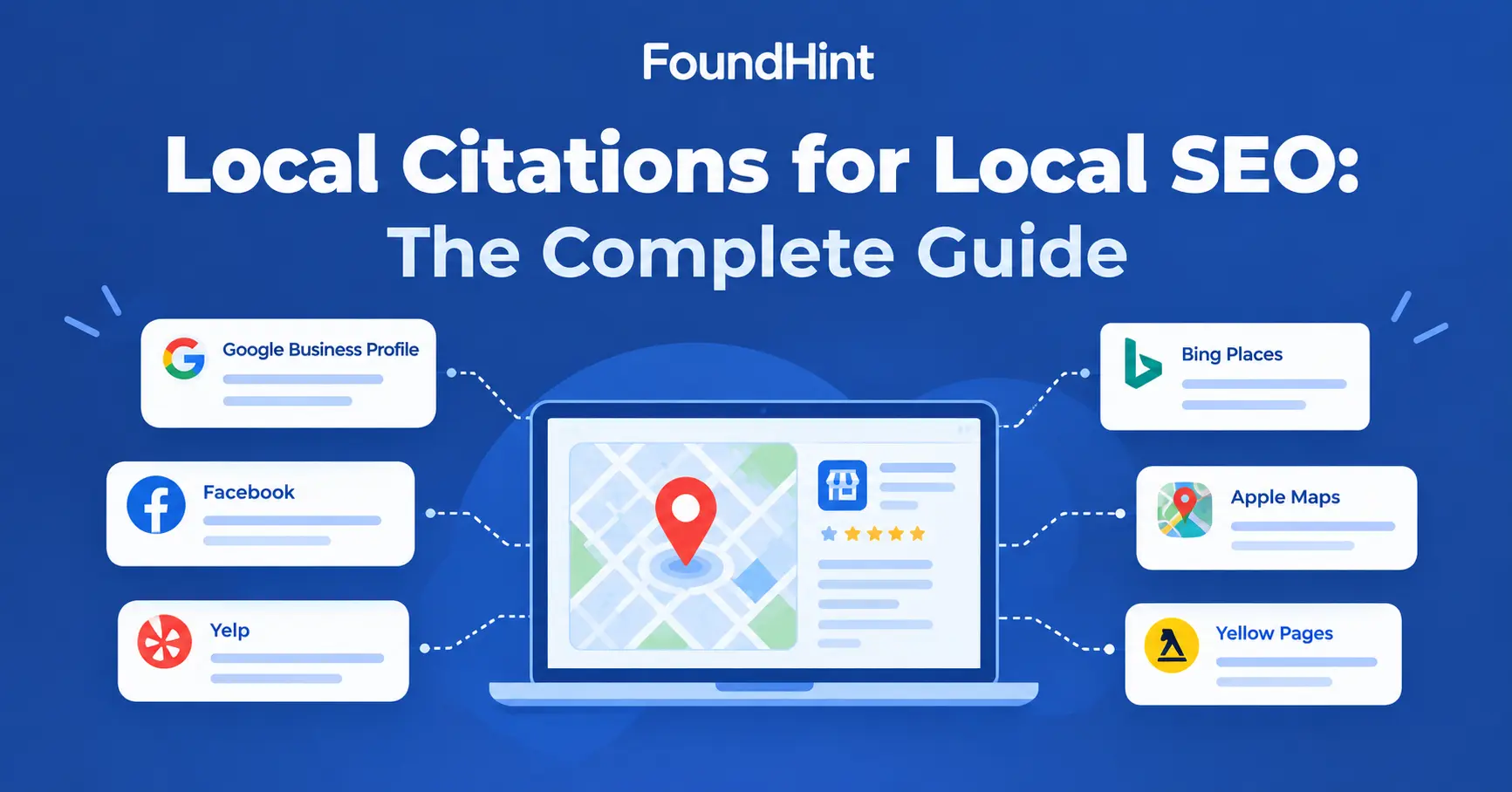
Every time your business name, address, and phone number appear on another website, such as Yelp, the Better Business Bureau, a local chamber of commerce, or a news article, that mention is a local citation.
Together, these mentions help search engines confirm that your business is real, where it is, and how customers can reach it.
But local citations for Local SEO are only useful when they’re accurate.
An old address on one directory, a different phone number on another, and a duplicate listing on a third can send mixed signals to both customers and search engines.
In this complete guide to local citations for SEO, you’ll learn:
- What local citations are and why they matter for local SEO
- The difference between citations, listings, and backlinks
- How to build local citations step by step
- Where to get local citations, and which sources to skip
- How to run a local SEO citation audit and clean up errors
- How to manage citations for small businesses, multiple locations, and service-area businesses
- How the FoundHint local citation check helps you find and fix citation problems faster
What Are Local Citations?
A local citation is any online mention of your business’s key information, usually its name, address, and phone number (NAP), on a website other than your own.
Many citations also include your website URL, business category, hours, and services.
So what are citations in local SEO? They are the business information signals that appear across external websites, helping search engines verify your business details.
A local SEO citation doesn’t need to include a link; the mention of your business details is what counts.
Local citation example
Here’s a simple local citation example for a plumbing company in Austin, Texas, as it might appear on a business directory:
Lone Star Plumbing 1200 Congress Ave, Austin, TX 78701 (512) 555-0147 · lonestarplumbing.com Category: Plumber · Mon–Sat 7 AM–7 PM
A citation’s core parts are:
- Business name – your real business name
- Address – your physical address (or service area)
- Phone number – your main local number
- Website – your homepage or location page URL
- Additional business information – category, hours, services, photos, and description
Why Are Local Citations Important for Local SEO?
Why are citations important for local SEO?
Because search engines don’t rely on your website alone. They compare information from many sources to decide how confident they are about your business.
The main benefits of local citations are:
| Benefit | How it helps |
|---|---|
| Business information consistency | Matching details across the web confirm your business is accurate and current |
| Local business discovery | Customers find you on directories, maps, and apps beyond Google |
| Entity understanding | Search engines connect mentions of your business into one clear business entity |
| Local visibility | You show up in more places where local customers search |
| Trust and prominence | Mentions on reputable local and industry sites signal that your business is established |
| Directory visibility | Listings on major directories can rank on their own for local searches |
The importance of local citations for SEO comes from accuracy and relevance, not raw volume. There is no magic number of citations that guarantees rankings.
A smaller set of accurate citations on trusted, relevant sites usually beats hundreds of listings on low-quality directories.
Local Citations vs Business Listings
What is the difference between listings and citations? The terms overlap, which causes confusion. Here’s how they relate:
| Term | What it is | Example |
|---|---|---|
| Citation | Any mention of your business NAP on another site | Your name, address, and phone in a local news article |
| Business listing | A dedicated profile for your business on a platform | Your Yelp business page |
| Directory profile | A business listing on a directory site | Your page on the BBB or Angi |
| Google Business Profile | Google’s own business listing that powers Maps and the Local Pack | Your profile in Google Maps |
| Backlink | A link from another website to yours | A local blog linking to your site |
In short, every business listing is a citation, but not every citation is a listing.
Local listings vs citations is really a question of format: a listing is a structured profile you usually control, while a citation can be any mention.
Local citations and directories go hand in hand because directories are the most common source of structured citations.
Types of Local Citations
Structured citations
Structured citations appear in a consistent, organized format, usually on platforms built to list businesses:
- Business directories – Yelp, Better Business Bureau, Yellow Pages
- Industry directories – Avvo for lawyers, Healthgrades for doctors, Houzz for contractors
- Local directories – city business directories and regional guides
- Mapping platforms – Apple Maps (Apple Business Connect), Bing Places
- Business profiles – Facebook business pages, Nextdoor business pages
A local directory citation is the most common type of structured citation for small businesses.
Unstructured citations
Unstructured citations mention your business inside other content, rather than in a fixed listing format:
- Local news – a story about your business opening or community work
- Blogs – “best coffee shops in Denver” roundups
- Community websites – neighborhood associations and event pages
- Sponsorships – a youth sports team listing its sponsors
- Organizations – member lists for trade associations
- Local publications – city magazines and visitor guides
Unstructured citations are harder to build, but they often come from more trusted, relevant local sources.
What Information Should a Local Citation Include?
The more complete your local business listing information, the more useful each citation becomes for customers and search engines.
| Information | Example |
|---|---|
| Business name | ABC Plumbing |
| Address | 123 Main Street, Phoenix, AZ 85004 |
| Phone | +1 602-555-0134 |
| Website | abcplumbingphoenix.com |
| Category | Plumber |
| Hours | Mon–Fri 8 AM–6 PM |
| Services | Drain cleaning, water heater repair, leak detection |
| Description | Short, accurate summary of what you do and where |
| Photos and logo | Real images of your team, vehicles, or storefront |
At a minimum, every citation needs accurate NAP. Everything else adds context and helps customers choose you.
NAP Consistency and Local Citations
NAP consistency means your business name, address, and phone number are the same everywhere they appear.
It’s the heart of NAP local SEO and the main goal of any citation audit or citation cleanup.
| Element | What “consistent” means | Common problem |
|---|---|---|
| Name consistency | Same official business name everywhere | “ABC Plumbing” vs “ABC Plumbing & Drain LLC” |
| Address consistency | Same address format and suite number | “Ste 200” on one site, missing suite on another |
| Phone consistency | Same main local number | Old number or call-tracking number on some listings |
| Website consistency | Same URL (https, www or not) | Old domain or HTTP link still listed |
Local citation consistency usually breaks down because of:
- Duplicate listings – two profiles for the same business on one platform
- Old business information – outdated hours, phone numbers, or websites
- Rebranding – a new business name that hasn’t been updated everywhere
- Relocations – an old address still showing after a move
Small differences in abbreviations, such as “St” vs “Street,” are rarely a serious problem. Wrong phone numbers, old addresses, and different business names are the issues worth fixing first.
How to Build Local Citations?
How do you do local citations the right way? Local citation building isn’t about submitting your business to as many sites as possible. It’s about getting accurate information onto the right sources, and keeping it accurate.
Here’s a nine-step process for how to build citations for local SEO.
Step 1: Create your master business information
Write down one official version of your business details and use it everywhere:
- Business name (exactly as on your signage and Google Business Profile)
- Address (with consistent suite and abbreviation format) or service areas
- Main phone number
- Website URL
- Primary and secondary categories
- Hours, services, short and long descriptions
- Logo and photos
This “source of truth” document prevents small differences from creeping in.
Step 2: Identify important citation sources
List the platforms that matter most for your business: major directories, mapping platforms, your industry’s top directories, and local sources in your city.
Step 3: Claim existing listings
Many platforms already have a listing for your business, created automatically from public data. Search for your business on each platform and claim or verify existing listings before creating anything new. This avoids duplicates.
Step 4: Create missing listings
Where no listing exists, create one using your master information. Complete every relevant field.
Step 5: Keep NAP information consistent
Copy and paste from your master document rather than typing details from memory.
Step 6: Remove or resolve duplicates
If you find two listings for the same business on one platform, request a merge or removal through that platform’s support process.
Step 7: Update incorrect information
Fix old phone numbers, addresses, hours, and websites on listings you’ve claimed.
Step 8: Track your citation sources
Keep a record of every listing: platform, URL, login owner, date created, and date last checked.
Step 9: Audit citations regularly
Check your citations every few months, and immediately after any move, phone change, or rebrand.
How to build local citations for small business owners with limited time: start with Google Business Profile, Apple Business Connect, Bing Places, Yelp, Facebook, and BBB, then add your two or three most important industry directories and one or two strong local sources such as your chamber of commerce.
Where to Get Local Citations?
Where can you get citations? Instead of chasing a giant generic list, choose local citation sites based on three questions: Do my customers use it? Is it relevant to my industry or city? Is it a trusted, real platform?
| Source type | US examples | Why it matters |
|---|---|---|
| Search and mapping platforms | Google Business Profile, Apple Business Connect, Bing Places | Power map results across devices and apps |
| Major business directories | Yelp, Better Business Bureau, Yellow Pages, Foursquare | Widely used, often rank for local searches |
| Social business profiles | Facebook, Nextdoor, LinkedIn company pages | Customers check them for reviews and updates |
| Industry directories | Avvo, FindLaw (legal); Healthgrades, Zocdoc (medical); Houzz, Angi (home services); TripAdvisor (hospitality) | Highly relevant to your category |
| Local directories | City or county business directories, regional guides | Strong local relevance |
| Chamber of Commerce | Your city’s chamber member directory, e.g. the Greater Austin Chamber | Trusted local membership signal |
| Professional organizations | State bar associations, trade associations | Proves credentials and relevance |
| Local publications | City magazines, local news sites | Unstructured citations with local trust |
| Community websites | Neighborhood associations, local event sites | Genuine community presence |
| Relevant niche websites | Wedding vendor directories, pet care directories | Reach customers in your niche |
Free local citations are available on most of these platforms: Google Business Profile, Apple Business Connect, Bing Places, Yelp, Facebook, and many industry directories all offer free listings.
Paid options exist, but start with the free, high-value sources.
Use this local citation list USA approach as a starting framework, then adjust it to your industry and city.
Local Citation Submission
Local citation submission is the process of adding or updating your business information on citation sources. Good citation building strategies focus on quality and accuracy:
- Manual submission – create listings yourself, field by field, using your master information.
- Claiming existing profiles – always check whether a listing already exists before submitting a new one.
- Business verification – complete phone, email, postcard, or video verification where the platform offers it.
- Information consistency – paste from your master document every time.
- Submission tracking – log every platform, URL, and login so you can update listings later.
- Avoiding spam directories – skip sites that exist only to sell links, accept every business without review, or are full of spam listings.
If you use a local citation building service or local citation generator tool, make sure you keep ownership and login access to every listing it creates.
Local Citation Cleanup
What is citation cleanup? Local citation cleanup is the process of finding and fixing inaccurate, outdated, or duplicate citations so your business information is consistent everywhere.
What to find
- Incorrect listings – wrong name, address, phone, website, or hours
- Duplicate listings – more than one profile for the same location on a platform
- Old addresses – listings still showing a previous location
- Old phone numbers – disconnected or former numbers
- Wrong categories – “Contractor” when you’re a “Roofing contractor”
How to fix it
- Claim the listing so you have permission to edit it.
- Update information to match your master business details.
- Merge duplicates where possible, using the platform’s merge tool or support team.
- Remove inappropriate duplicates that can’t be merged, such as listings for a closed location.
- Correct business details on unstructured citations by contacting the site owner with a polite update request.
Citation consistency improves gradually as platforms update. Prioritize the most visible platforms first.
How to Audit Local Citations?
A local SEO citation audit shows you where your business appears, what’s wrong, and what’s missing. How can you check your SEO citations?
- Search your business name plus your city on Google and each major platform.
- Search your phone number and old phone numbers, which often reveal forgotten or duplicate listings.
- Search old addresses if you’ve moved.
- Record every listing in a spreadsheet or citation tool.
- Compare each listing to your master business information.
- Mark issues and prioritize fixes by platform importance.
This is also how to find local citations you didn’t know existed.
Local citation audit checklist
| Check | What to look for |
|---|---|
| Business name | Matches your official name exactly |
| Address | Correct street, suite, city, ZIP |
| Phone | Current main number |
| Website | Correct, working URL |
| Category | Most relevant category selected |
| Hours | Current regular and holiday hours |
| Duplicate listings | Only one listing per location per platform |
| Missing listings | Important platforms where you’re not listed |
| Incorrect listings | Any field that doesn’t match your master data |
| Inconsistent NAP | Variations across platforms |
| Broken links | Website links that return errors |
| Closed locations | Listings for locations that no longer operate |
FoundHint local citation check: Instead of searching platform by platform, the FoundHint Local SEO Plugin includes a local citation check that compares your business information against your citations and highlights inconsistent NAP, missing listings, and other issues to fix, all from your WordPress dashboard.
Local Citation Tools
Manual citation work is fine for a handful of listings. Beyond that, a local citation tool saves hours. Common tool types include:
| Tool type | What it does | Best for |
|---|---|---|
| Local citation finder tool / software | Discovers where your business is already listed | Audits and finding forgotten listings |
| Local citation checker (free or paid) | Compares listings against your correct NAP | Spotting inconsistencies |
| Local citation generator / submission tool | Creates or distributes listings across platforms | New businesses and multi-location rollouts |
| Local citation API | Lets developers pull or push citation data programmatically | Agencies and large multi-location brands |
| Citation management platform | Tracks listings, logins, and updates over time | Ongoing local citation management |
When choosing a tool, check whether it shows real listing URLs, lets you keep ownership of listings, and supports your industry and country.
Check your citations with FoundHint
The FoundHint Local SEO Plugin now includes a local citation check feature, built for WordPress local businesses that want citation auditing in the same place they manage their website.
Here’s how the FoundHint citation audit workflow works:
Master business information (saved in FoundHint)
        ↓
Local citation check
        ↓
Inconsistencies and issues highlighted
        ↓
Fix listings on each platform
        ↓
Re-check and track progress| Citation problem | How FoundHint’s local citation check helps |
|---|---|
| Different business names across listings | Flags name variations against your saved business information |
| Old addresses or phone numbers | Highlights NAP that doesn’t match your current details |
| Missing listings on important platforms | Shows citation gaps to fill |
| Not knowing where to start | Gives you a clear list of issues to prioritize |
| Losing track over time | Lets you re-run the check after updates and keep citations consistent |
Because FoundHint also manages your website’s business information and LocalBusiness schema, your WordPress site, structured data, and citations all work from the same master business details. That’s the simplest way to keep NAP consistency across everything.
Local Citations and Backlinks
Are local citations backlinks? Not necessarily. A citation is not the same as a backlink.
| Local citation | Backlink | |
|---|---|---|
| What it is | A mention of your business information | A link from another website to yours |
| Needs a link? | No | Yes |
| Main value | Confirms your business details | Passes authority and referral traffic |
| Example | “Lone Star Plumbing, (512) 555-0147” in a news article | A blog post linking to lonestarplumbing.com |
A citation can mention a business without linking to its website. A backlink is primarily a link from another website to your website. Some citations include a link, so they work as both. Many directory links are nofollow, so treat local citation backlinks as a bonus, not the main goal.
Citation link building works best with relevant local sources such as chambers of commerce, sponsorships, local news, and associations, where you can earn both a citation and a meaningful link.
How Local Citations Affect Local SEO Rankings?
How do local citations impact local SEO rankings today? Local citations can help establish and reinforce business information across the web, but citation quantity alone should not be treated as a guaranteed local ranking factor.
Citations mainly support local rankings by:
- Reinforcing accuracy – consistent NAP gives search engines confidence in your business details
- Supporting prominence – mentions on trusted local and industry sites show your business is established
- Improving discovery – more customers find you on platforms beyond Google
Do citations still matter for local SEO? Yes, but their role has changed. Building hundreds of directory listings no longer moves the needle. Accurate core citations, strong industry and local sources, and fixing inconsistencies matter far more.
How local citations impact your business’s online visibility also goes beyond rankings: a customer who finds a wrong phone number on Yelp is a lost lead, whatever your ranking.
For the bigger picture, read Local SEO Ranking Factors.
Local Citations for Small Businesses
Small businesses don’t need hundreds of listings. They need a focused, accurate set. Here’s a practical small-business workflow for local citations for SEO:
| Week | Task |
|---|---|
| Week 1 | Create master business information; claim Google Business Profile, Apple Business Connect, and Bing Places |
| Week 2 | Claim or create Yelp, Facebook, BBB, and Yellow Pages listings |
| Week 3 | Add your top 2–3 industry directories |
| Week 4 | Add local sources: chamber of commerce, city directory, local associations |
| Ongoing | Run a citation check every 3 months and after any business change |
Most of these are free local citations, so a small business can build a strong foundation without paid tools.
Local Citations for Multi-Location Businesses
How do you maintain updated local citations for business locations when you have several? Treat each location as its own business entity.
- Location-specific information – each branch has its own address, local phone, and hours.
- Separate listings – create one listing per location on each platform, never one listing for several branches.
- Location pages – link each listing to that location’s page on your website (e.g. /locations/round-rock/), not just the homepage.
- Address consistency – use one format per location across all platforms.
- Phone consistency – give each location its own local number and use it everywhere.
- Duplicate prevention – check for auto-created duplicates whenever you open, move, or close a location.
Multi-location citation management gets complex quickly, so a central master record for every location, plus a regular citation check, is essential.
Local Citations for Service-Area Businesses
Contractors, plumbers, electricians, HVAC companies, roofers, cleaning businesses, and other home services often work at customers’ homes and don’t have a storefront.
Local citation management for contractor service areas works a little differently:
- Hide your address where the platform allows, if customers don’t visit you, and list service areas instead.
- Use the same service areas across your Google Business Profile, website, and citations.
- Don’t create fake addresses or virtual offices in every city you serve. This violates platform guidelines and can get listings removed.
- Prioritize home-service directories such as Angi, HomeAdvisor, Houzz, and Thumbtack, plus your local chamber and trade associations.
- Keep one consistent phone number rather than separate tracking numbers for each city.
For service-area businesses, accurate service areas matter as much as accurate NAP.
Industry-Specific Local Citations
Industry directories are often the most valuable citations after the major platforms, because they’re relevant and used by customers comparing providers.
| Industry | Example citation sources (US) | Tip |
|---|---|---|
| Local citations for contractors | Angi, HomeAdvisor, Houzz, BuildZoom, BBB | Keep license numbers and service areas consistent |
| Local citations for car dealerships | Cars.com, CarGurus, Edmunds, DealerRater | Match each rooftop’s address and sales/service phone numbers |
| Attorney local citations / local citations for law firms | Avvo, FindLaw, Justia, Martindale-Hubbell, state bar directory | Use the firm name exactly as registered; list each office separately |
| Property managers | Apartments.com, Zillow, local apartment associations | Keep office address and leasing phone separate from property listings |
| Medical and dental | Healthgrades, Zocdoc, WebMD, Vitals | List each practitioner and location accurately |
| Restaurants | TripAdvisor, OpenTable, Yelp | Keep hours and menu links current |
| Other service businesses | Thumbtack, Nextdoor, trade association directories | Focus on platforms your customers actually use |
Start with the top two or three sources for your industry rather than trying to cover every niche site.
Common Local Citation Mistakes
These citation mistakes cause most inconsistent citations, and most citation cleanup work.
| Mistake | Why it hurts | Fix |
|---|---|---|
| Wrong business name | Splits your business into several “entities” | Use your exact official name everywhere |
| Wrong address | Sends customers and search engines to the wrong place | Update or claim the listing |
| Wrong phone | Lost calls and inconsistent NAP | Use one main local number |
| Old website | Broken or outdated links | Update URLs after any domain change |
| Duplicate listings | Splits reviews and confuses platforms | Merge or remove duplicate citations |
| Wrong category | Shows you for the wrong searches | Choose the most specific relevant category |
| Fake locations | Violates guidelines; listings can be suspended | List only real locations |
| Low-quality directories | Little value and possible spam association | Focus on trusted, relevant sources |
| Inconsistent information | Weakens trust in your details | Work from one master record |
| Ignoring old listings | Old data keeps spreading | Search old names, phones, and addresses |
| Building citations without auditing them | Adds new listings while errors remain | Run a citation audit before building more |
Local Citation Checklist
Business information
- Business name is correct
- Address is correct
- Phone is correct
- Website is correct
- Category is relevant
- Hours are correct
Citation management
- Major listings claimed
- Industry listings created
- Local directories reviewed
- Duplicate listings identified
- Incorrect listings fixed
- Old listings updated
- Citation sources tracked
Audit
- NAP checked
- Citation gaps identified
- Duplicate listings reviewed
- Citation consistency checked
- Regular audit scheduled (tip: run the FoundHint local citation check every quarter)
Frequently Asked Questions
What are citations in local SEO?
Citations in local SEO are online mentions of your business name, address, and phone number on other websites, such as directories, maps, social platforms, and local news sites.
What is a local citation?
A local citation is a single mention of your business information on a website other than your own, with or without a link to your site.
What is local citation building?
Local citation building is the process of creating, claiming, and updating your business listings on relevant platforms so your business information is accurate and consistent across the web.
Why are local citations important?
They help search engines confirm your business details, help customers find you on more platforms, and support your business’s prominence in local search.
Do citations help local SEO?
Yes. Accurate, consistent citations support local SEO, but citation quantity alone doesn’t guarantee higher rankings.
Do citations still matter for local SEO?
Yes, but quality and accuracy now matter far more than volume. Core platforms, industry directories, and strong local sources are what count.
How do I build local citations?
Create your master business information, claim existing listings, create missing listings on relevant platforms, keep NAP consistent, fix duplicates and errors, and audit regularly.
How do I build local citations for a small business?
Start with Google Business Profile, Apple Business Connect, Bing Places, Yelp, Facebook, and BBB, then add your top industry directories and your local chamber of commerce.
Where can I get local citations?
From mapping platforms, major business directories, industry directories, local directories, chambers of commerce, professional organizations, local publications, and community websites.
How do I find local citations?
Search your business name, phone numbers (current and old), and addresses on Google and major platforms, or use a local citation finder tool.
How do I check my SEO citations?
Compare each listing to your master business information, either manually in a spreadsheet or with a local citation checker such as the FoundHint local citation check.
What is citation cleanup?
Citation cleanup is fixing incorrect, outdated, and duplicate listings so your business information is consistent everywhere.
What is the difference between listings and citations?
A listing is a dedicated business profile on a platform. A citation is any mention of your business information. Every listing is a citation, but not every citation is a listing.
Are local citations backlinks?
Not always. A citation can mention your business without linking to your website. Some citations include a link and act as both.
How do local citations affect local rankings?
They reinforce accurate business information and support prominence. They work alongside your Google Business Profile, reviews, relevance, and proximity, not on their own.
How many local citations does a business need?
There’s no fixed number. Focus on the major platforms, your key industry directories, and relevant local sources, and keep them all accurate.
How should multi-location businesses manage citations?
Create separate listings for each real location, with its own address, phone number, and location page URL, and audit each location regularly.
How should service-area businesses manage citations?
Hide the address where appropriate, list consistent service areas, avoid fake addresses, and prioritize home-service and local directories.
Final Thoughts
Local citations are one of the simplest local SEO foundations to get right, and one of the easiest to let slip. Build accurate citations on platforms that matter, keep NAP consistent, clean up old and duplicate listings, and audit regularly.
The FoundHint local citation check makes that last step easy: it compares your business information against your citations, highlights what needs fixing, and lets you re-check as you go, right inside WordPress.
To keep learning, read What Is Local SEO? The Complete Guide, Local SEO Ranking Factors, LocalBusiness Schema for WordPress, and Local SEO Audit.