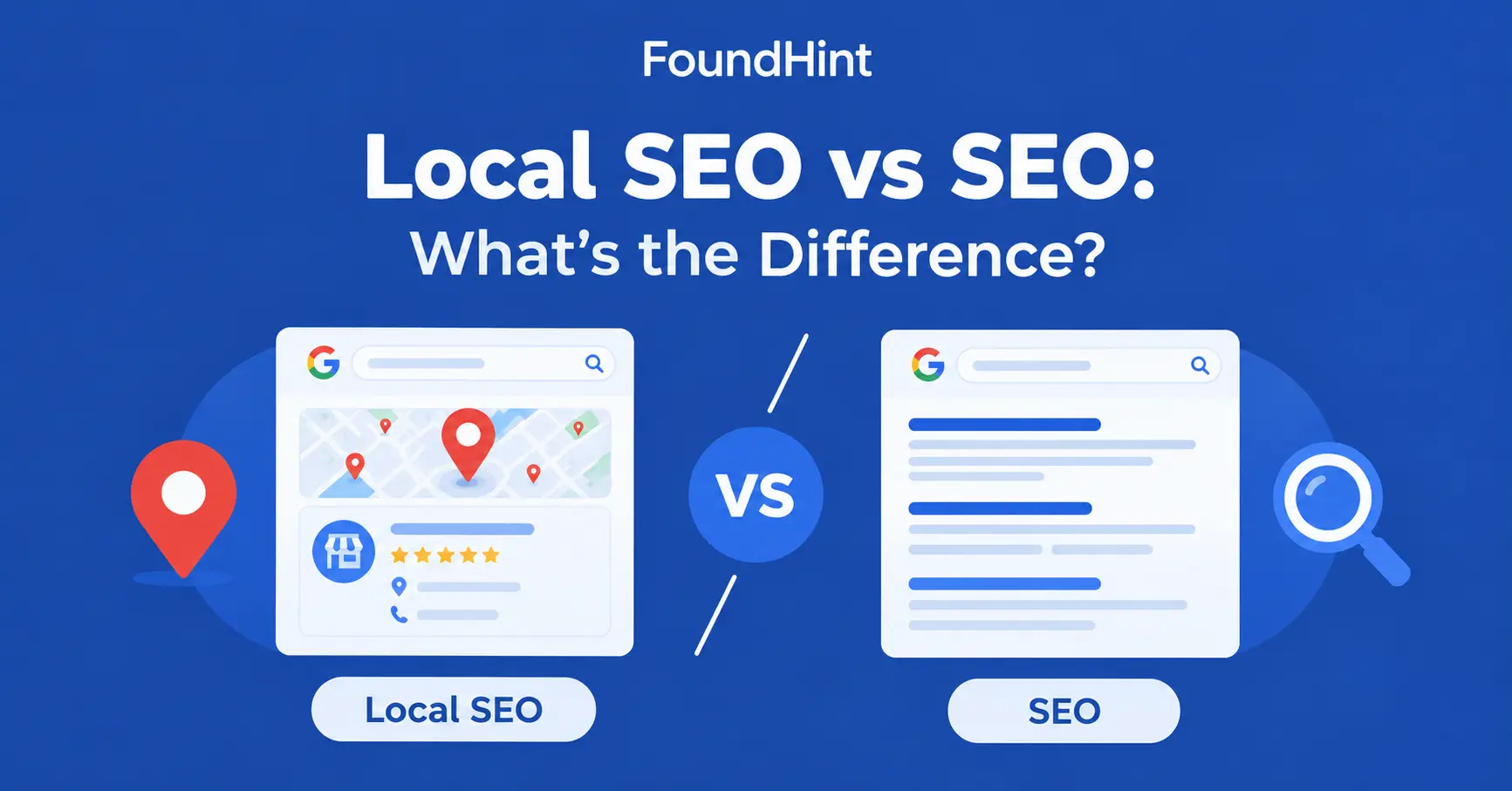
SEO focuses on improving a website’s visibility in search engines, while local SEO focuses specifically on visibility for searches connected to a particular location.
That is the short answer.
But local SEO is not a completely separate discipline.
It is a specialized part of SEO that uses the same foundations, such as keywords, content, technical SEO, and links, then adds a layer of local signals like Google Business Profile, reviews, and business location.
In this guide, you will learn what SEO and local SEO each mean, the key differences between them, where they overlap, and how to decide which one your business needs.
For most local businesses, the answer is both.
 FoundHint Local SEO WordPress
Optimize your Google Business Profile without leaving WordPress
Connect your profile, compare it with your website and fix the gaps FoundHint finds.
- Business Profile audit and optimization
- Google Post scheduling
- Review management and replies
- Local rank tracking on a map grid
What Is SEO?
SEO (search engine optimization) is the practice of improving a website so it earns more visibility in organic search results.
Organic results are the unpaid listings that search engines like Google rank based on relevance and quality.
Traditional SEO, sometimes called organic SEO, usually covers:
- Keywords – finding the words and phrases people use to search for your topic.
- Search intent – understanding what the searcher actually wants, whether information, a comparison, or a purchase.
- Content – creating helpful pages that answer those searches better than competing pages.
- Technical SEO – making sure search engines can crawl, index, and understand your site, and that it loads quickly.
- Links – earning backlinks from other websites, which signal trust and authority.
- Website authority – building a reputation over time as a reliable source in your field.
Traditional SEO often targets a national or global audience.
A blog about personal finance or an online store shipping across the country may not care where the searcher is located. It cares about matching the topic and intent.
What Is Local SEO?
Local SEO (local search engine optimization) is the practice of improving a business’s visibility in local search results, the results people see when they search for something in or near a specific place.
In simple terms, local SEO helps local businesses get found by local customers.
It is built around geographic intent: searches like “dentist near me” or “plumber in Dhaka,” where the best answer depends on location.
Local SEO usually covers:
- Local search: Helps people find your business nearby.
- Google Business Profile: Shows your business on Google Search and Maps.
- Google Maps: Helps customers find your location.
- Local Pack: Shows top local businesses in search results.
- Local keywords: Target searches like “salon in Gulshan.”
- Reviews: Build trust and improve visibility.
- Citations: List your business details across the web.
New to the topic? Start with What Is Local Search? and What Is Local SEO? The Complete Guide.
Local SEO vs SEO: Key Differences
The main difference is focus: SEO aims for organic visibility wherever your audience is, while local SEO aims for visibility among customers in a specific area.
| Factor | SEO | Local SEO |
|---|---|---|
| Main goal | Organic visibility | Local visibility |
| Geographic focus | May be global or national | Location-focused |
| Target audience | Broad audience | Local customers |
| Google Business Profile | Usually not central | Very important |
| Google Maps | Not usually central | Important |
| Local Pack | Not primary | Important |
| Keywords | Topic-based | Location + service intent |
| Reviews | May support reputation | Important for local businesses |
| Citations | Less central | More relevant |
| Location pages | Optional | Often important |
| Local schema | Optional depending on site | Often relevant |
| Local backlinks | Useful | Particularly valuable |
| Search intent | Informational, commercial, and more | Often includes local intent |
Notice the pattern: almost everything in the SEO column still applies to local SEO. Local SEO simply adds more weight to location, business listings, and local reputation.
How Local SEO and SEO Are Similar?
Local SEO and SEO share the same foundation. If your website is weak, local SEO has less to build on.
Both can involve:
- Keyword research
- Content optimization
- Technical SEO
- Internal linking
- Backlinks
- Search intent
- Mobile optimization
- Page speed
- Structured data
- Search visibility
Key point: Local SEO uses many of the same SEO principles but adds geographic and local-business signals.
Think of SEO as the base of a building and local SEO as the floor built on top for local customers. You need the base before the top floor can stand.
Local SEO Has Additional Local Signals
On top of standard SEO, local SEO adds signals that tell search engines where a business is, what it does, and whether local customers trust it.
Google Business Profile
Your Google Business Profile is the core of local SEO. It controls what people see in the Local Pack and Google Maps: name, category, hours, photos, reviews, and contact details.
See Google Business Profile Optimization.
Google Maps
Many customers search directly in Google Maps. Ranking there depends on your business profile and local signals more than on website SEO alone.
See Google Maps SEO.
Business Location
Where your business is located affects which searches it can appear for. A business in Banani has a natural advantage for searches made nearby.
Local Search Intent
Local SEO targets searches with geographic intent, such as “near me” searches, city searches, and queries where Google assumes the searcher wants nearby results.
Customer Reviews
GBP Reviews influence both customer decisions and local visibility. The number, quality, and recency of reviews, plus how you respond, all matter.
Local Citations
Local Citations are mentions of your business details on directories, local websites, and platforms. They help confirm that your business is real and where it is.
NAP Information
NAP stands for name, address, and phone number. NAP consistency across your website, profile, and citations helps search engines trust your information.
Local Business Categories
Your Google Business Profile category tells Google what type of business you are. Choosing the most accurate primary category is one of the most important local SEO decisions.
Service Areas
Service-area businesses, such as plumbers or cleaners who travel to customers, can define the areas they serve instead of showing a public address.
Local SEO vs SEO: Keyword Differences
The clearest way to see the difference is in the keywords each one targets.
| Traditional SEO keywords | Local SEO keywords |
|---|---|
| best running shoes | plumber in Dhaka |
| how to fix a leaking faucet | dentist near me |
| digital marketing strategy | best restaurant in Dhaka |
| what is a root canal | local SEO agency Dhaka |
Traditional SEO keywords are usually topic + intent. Local SEO keywords add a third part: topic + intent + location.
That location can be written out (“in Dhaka”), implied by “near me,” or inferred by Google from the searcher’s context.
To find the right local terms for your business, read Local Keyword Research.
Local SEO vs SEO: Search Results
SEO and local SEO also aim for different parts of the search results page.
| Traditional SEO results | Local SEO results |
|---|---|
| Organic search results | Local Pack |
| Featured snippets | Google Maps |
| Images | Local Finder |
| Videos | Organic local results |
| Other SERP features | Business Profile information |
For a local search, one page can show both. A searcher looking for “dentist in Dhaka” may see the Local Pack at the top, followed by organic results for clinic websites and directories.
A business with strong SEO and strong local SEO can appear in both places.
Which Businesses Need Local SEO?
Any business that serves customers in a specific area can benefit from local SEO. That includes:
- Restaurants and cafes
- Dentists
- Lawyers
- Plumbers
- Contractors
- Salons
- Medical practices
- Retail stores
- Real estate businesses
- Local agencies
- Service-area businesses that travel to customers
- Multi-location businesses with branches in several cities
If a customer would ever search for your business with a city name or “near me,” local SEO is relevant to you.
Do You Need Local SEO or Traditional SEO?
Use this simple framework to decide what fits your business.
| Your situation | What you need |
|---|---|
| Customers visit your physical location | Local SEO + SEO |
| You serve customers in a geographic area | Local SEO + SEO |
| You operate nationally | SEO |
| You operate internationally | SEO |
| You have multiple locations | Local SEO + SEO + multi-location SEO |
For many local businesses, the strongest recommendation is not either/or. It is:
Use traditional SEO for your website and local SEO to improve visibility in location-based searches.
Can Local SEO and SEO Work Together?
Absolutely. They work best together. Each part strengthens the others:
Website SEO + Google Business Profile + Local content + Reviews + Citations + Local links = Stronger local search visibility
A well-optimized website gives Google more reasons to trust your business profile. A strong business profile and good reviews send more visitors to your website. Local content and links support both.
Local SEO vs SEO for Small Businesses
Most small local businesses need both, because their customers search in two different ways.
Take a dentist as an example:
| Approach | Example search | What it captures |
|---|---|---|
| SEO | “root canal treatment” | People researching a topic or treatment |
| Local SEO | “dentist in Dhaka” | People ready to choose a nearby clinic |
By doing both, the dentist gets opportunities from topic-based searches and location-based searches. The person reading about root canal treatment today may be the patient searching “dentist in Dhaka” next week.
Local SEO vs SEO for Google Maps
Traditional website SEO alone is not the same as optimizing a business for Google Maps. A website can rank well in organic results and still be invisible in Maps if its business profile is weak.
Google Maps visibility depends mainly on:
- Google Business Profile – a complete, verified, active profile.
- Category – the primary and secondary categories you choose.
- Business information – accurate name, address, phone, hours, and services.
- Reviews – genuine reviews and your responses to them.
- Location – where your business is based or which areas it serves.
Google describes local ranking in terms of three main ideas:
| Factor | What it means |
|---|---|
| Relevance | How well your business matches the search |
| Distance | How close your business is to the searcher or searched location |
| Prominence | How well known and trusted your business appears |
Your website still supports prominence and relevance, which is why SEO and local SEO work best together.
For more detail, read Local SEO Ranking Factors.
Common Local SEO and SEO Mistakes
Many businesses lose visibility because they treat SEO and local SEO as either/or, or skip the basics. Watch out for these mistakes.
Treating Local SEO as Only Google Business Profile
Your profile is essential, but it is only one part of local SEO. Your website, reviews, citations, and local links all support it.
Ignoring Website SEO
A slow, thin, or poorly structured website weakens your local visibility. Local SEO needs a solid SEO foundation underneath it.
Keyword Stuffing Location Names
Repeating “best dentist Dhaka” again and again makes pages hard to read and can look spammy. Use location terms naturally where they help the reader.
Creating Thin Location Pages
Location pages that only swap the city name add little value. Each page should include genuinely useful local details, such as services offered there, directions, team, or local examples.
Inconsistent Business Information
Different names, addresses, or phone numbers across your website, profile, and directories confuse both customers and search engines. Keep NAP details identical everywhere.
Ignoring Reviews
Unanswered reviews, or no reviews at all, make a business look inactive. Ask happy customers for honest reviews and reply to every one.
Creating Duplicate Content
Copying the same text across many pages, or from other websites, makes it harder for search engines to know which page to show. Write original content for each page.
A regular Local SEO Audit helps you catch these problems early. The FoundHint Local SEO Plugin can help you run those checks and spot issues like inconsistent business information before they hurt your visibility.
FoundHint Local SEO WordPress
Optimize your Google Business Profile without leaving WordPress
Connect your profile, compare it with your website and fix the gaps FoundHint finds.
- Business Profile audit and optimization
- Google Post scheduling
- Review management and replies
- Local rank tracking on a map grid
Local SEO vs SEO: Quick Summary
| Question | SEO | Local SEO |
|---|---|---|
| Improve website rankings? | ✅ | ✅ |
| Target local customers? | Sometimes | ✅ |
| Google Business Profile? | Not central | ✅ |
| Google Maps? | Not central | ✅ |
| Local Pack? | Not primary | ✅ |
| Local citations? | Less important | ✅ |
| Local reviews? | Helpful | Important |
| Location targeting? | Optional | Core |
Frequently Asked Questions
Is local SEO different from SEO?
Yes, but only partly. Local SEO uses the same foundations as SEO and adds local signals such as Google Business Profile, reviews, citations, and business location.
What is the difference between SEO and local SEO?
SEO improves a website’s visibility in organic search, often for a broad audience. Local SEO improves a business’s visibility for searches connected to a specific location, including the Local Pack and Google Maps.
Is local SEO part of SEO?
Yes. Local SEO is a specialized part of SEO focused on location-based searches and local customers.
Which is better, SEO or local SEO?
Neither is better in general. It depends on your customers. Businesses serving a local area usually need both, while national or international websites mainly need traditional SEO.
Does local SEO include Google Business Profile?
Yes. Google Business Profile is one of the most important parts of local SEO, because it controls how your business appears in the Local Pack and Google Maps.
Does local SEO help Google Maps rankings?
Yes. Optimizing your business profile, categories, reviews, and business information directly supports your visibility in Google Maps.
Do local businesses need both SEO and local SEO?
In most cases, yes. SEO helps your website rank for topic searches, and local SEO helps you appear for location-based searches when customers are ready to choose a business.
Is local SEO only for small businesses?
No. Local SEO also helps larger brands, franchises, and multi-location businesses appear in each area where they have a branch or serve customers.
Does local SEO work for service-area businesses?
Yes. Service-area businesses, such as plumbers and cleaners, can set their service areas in Google Business Profile and use local content and citations to build visibility in those areas.
Conclusion
Local SEO vs SEO is not really a choice between two separate strategies. SEO builds the foundation: keywords, content, technical health, and links.
Local SEO builds on that foundation with Google Business Profile, reviews, citations, NAP consistency, and location-focused content.
If your customers are in a specific area, you need both. Use SEO to rank for the topics people research, and local SEO to appear when they are ready to choose a business nearby.
To go deeper, read What Is Local SEO? The Complete Guide, Local Business Schema, and Local Citations.
Ready to put this into practice? The FoundHint Local SEO Plugin helps you manage and audit your local SEO, so you can see what is holding back your local search visibility and fix it with confidence.
FoundHint Local SEO WordPress
Optimize your Google Business Profile without leaving WordPress
Connect your profile, compare it with your website and fix the gaps FoundHint finds.
- Business Profile audit and optimization
- Google Post scheduling
- Review management and replies
- Local rank tracking on a map grid