Most local SEO advice is written for pizza shops, plumbers, and salons.
So if you run a commercial cleaning company, an IT services firm, a manufacturer, or a staffing agency, it’s fair to wonder whether any of it applies to you. Your buyers aren’t searching “near me” on a Friday night.
They’re procurement managers and business owners comparing vendors over weeks.
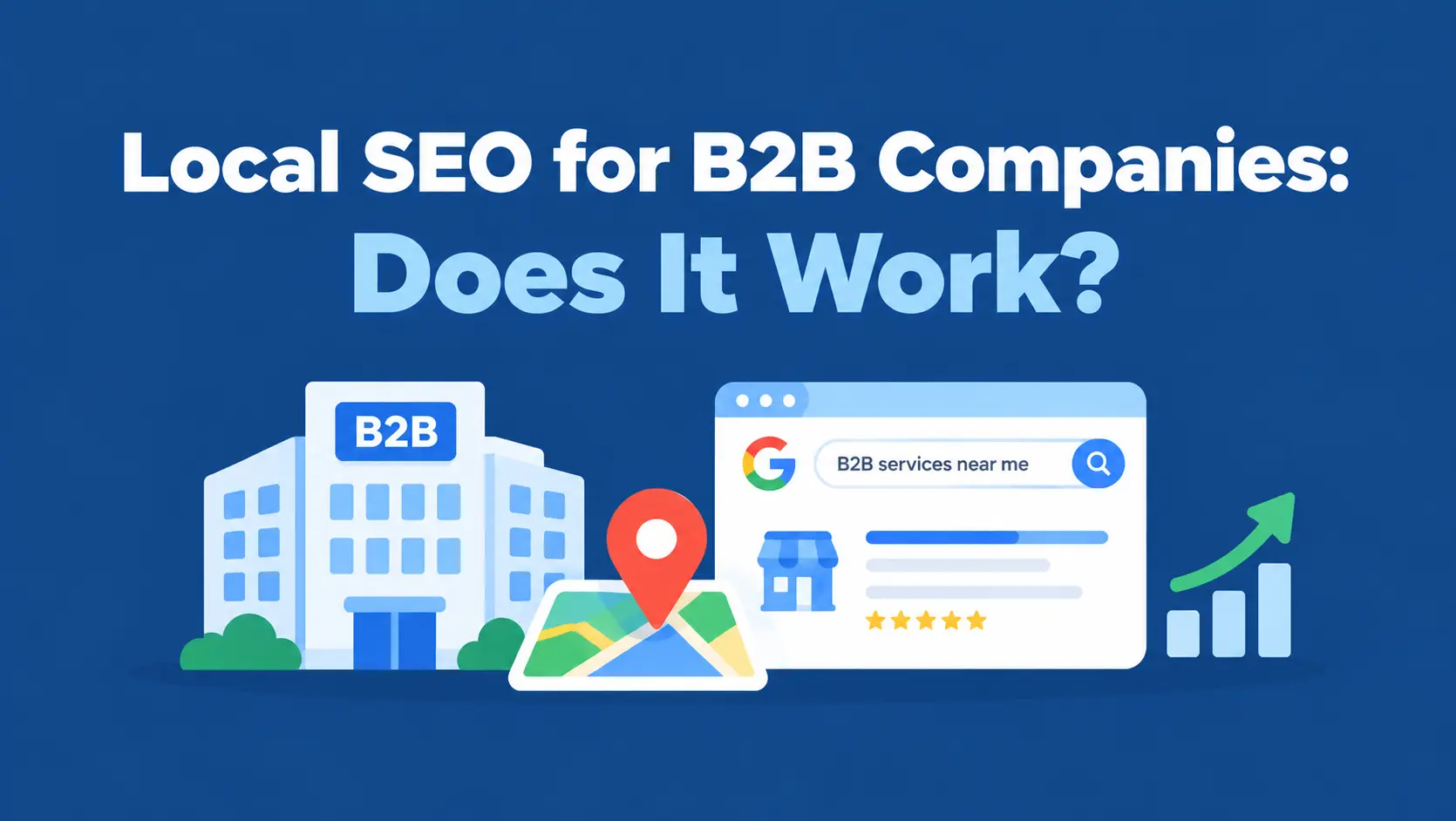
So does local SEO work for B2B companies? Often, yes, but not for every B2B business, and not in the same way as for consumer brands.
This guide explains which B2B companies benefit most, how B2B local search is different, whether you qualify for a Google Business Profile, the strategies that actually work, real keyword examples, how to measure results in leads and pipeline, and when local SEO simply isn’t the right fit.
Does Local SEO Work for B2B? The Short Answer
Yes, when your business serves clients in a specific area, meets them in person, or wins work partly because you’re nearby.
Many B2B buyers prefer local vendors for service, trust, and speed, and they search for them on Google just like consumers do.
B2B Companies That Benefit Most From Local SEO
| B2B business type | Why local search matters | Example searches |
|---|---|---|
| Commercial services (cleaning, HVAC, electrical, landscaping) | Work happens on-site within a service area | “commercial cleaning company Dallas” |
| IT services and managed service providers | Many clients want on-site support and a local partner | “managed IT services Charlotte” |
| Accounting, legal, and consulting firms | Business owners often want advisors they can meet | “small business accountant Denver” |
| Staffing and recruiting agencies | Hiring is often local or regional | “warehouse staffing agency Columbus” |
| Wholesale and distribution with pickup or showrooms | Buyers visit or pick up locally | “plumbing supply wholesale Phoenix” |
| Manufacturers and machine shops | Many buyers prefer nearby suppliers for speed and shipping costs | “CNC machine shop Houston” |
| Commercial real estate, printing, signage, and equipment rental | Local delivery, installation, or site visits | “commercial sign company Tampa” |
| Coworking and business services | Customers visit the location | “coworking space downtown Austin” |
If your clients could be anywhere in the country and never meet you, national SEO usually matters more.
Our guide to local SEO vs national SEO explains how to decide, and many B2B companies end up using both.
How B2B Local Search Is Different From B2C?
| Factor | B2C local search | B2B local search |
|---|---|---|
| Search volume | Often high | Usually lower |
| Value per lead | Often modest | Often much higher, sometimes a long-term contract |
| Buying cycle | Minutes to days | Weeks to months |
| Decision makers | One person | Often several people |
| Search terms | “near me,” “open now” | Specific services, industries, and certifications |
| What builds trust | Reviews, photos, hours | Case studies, credentials, client logos, reviews from businesses |
| Conversion | Call, visit, or order now | Quote request, consultation, demo, RFP |
What This Means for Your Strategy?
- Low volume isn’t a problem. A keyword with only 30 searches a month can be worth a lot if one new client is worth $20,000 a year.
- Your website does more of the selling. B2B buyers research before contacting you, so service pages, case studies, and credentials matter as much as your map listing.
- Trust signals are different. Reviews still help, but certifications, industry experience, and local case studies often carry more weight.
- Measure pipeline, not just clicks. Track quote requests, qualified leads, and deals, not only traffic.
Can a B2B Company Have a Google Business Profile?
Often, yes, but eligibility depends on how you serve customers, not whether they’re businesses or consumers.
Google’s guidelines for representing your business require in-person contact with customers.
| Situation | Eligible? |
|---|---|
| Clients visit your office, showroom, or warehouse during business hours | Generally yes, as a storefront |
| You travel to clients’ sites (commercial cleaning, IT support, HVAC) | Generally yes, as a service-area business with your address hidden |
| Both | Yes, show your address and add a service area |
| Fully remote work with no in-person contact (for example, purely online software) | Generally not eligible |
| A virtual office or mailbox where you don’t operate | Not eligible |
If you qualify, a Business Profile can put you in the map results for searches like “commercial cleaning company near me” or “IT support Charlotte,” which many B2B competitors still neglect.
Our guide to service area business SEO explains how to set it up if you travel to clients.
B2B Local SEO Strategies That Work
1. Optimize Your Google Business Profile for Business Buyers
- Choose precise categories, like “Commercial cleaning service,” “Computer support and services,” or “Industrial equipment supplier.” Our guide to Google Business Profile categories helps.
- List your services with descriptions written for business buyers, mentioning industries you serve.
- Add photos of your facility, team, equipment, and completed commercial projects.
- Post case studies, certifications, and industry updates rather than consumer-style promotions.
- Keep business hours accurate, since B2B buyers expect weekday availability.
2. Build Service Pages for Commercial Buyers
Create a page for each core service, written for business decision makers: what’s included, who it’s for, compliance or certifications, process, and how to request a quote.
Our guide to WordPress site structure for service businesses shows a practical layout.
3. Create Industry and Location Pages
B2B buyers often search by industry and location together, like “IT support for law firms in Denver” or “commercial cleaning for medical offices in Tampa.” Pages that combine a service, an industry, and a market can capture these high-value searches, as long as each page has genuinely useful, specific content.
See our guide to local landing page SEO examples for what makes these pages work.
4. Publish Local Case Studies
A case study about a local client is one of the strongest B2B trust signals. Include the client’s industry, the problem, your solution, results, and the city. Get permission first, or anonymize the client if needed.
5. Collect Reviews From Business Clients
B2B reviews are harder to get because buyers are busy and companies are cautious, so ask directly at natural milestones: after a project wraps, at a contract renewal, or after a positive check-in call. Make it easy with a direct review link.
Our guide to Google Business Profile reviews has practical tips.
6. List Your Business on B2B and Local Directories
Beyond Google, Apple, and Bing, B2B companies should consider:
- Your local chamber of commerce and business journal directories
- Industry associations and trade organizations
- B2B directories relevant to your field, like Clutch for agencies and IT firms or Thomasnet for manufacturers and industrial suppliers
- Better Business Bureau
Keep your details consistent everywhere. Our guide to local business listings for SEO covers best practices.
7. Earn Local B2B Links
Sponsor local business events, speak at chamber or association meetings, join business networking groups, partner with complementary local vendors, and pitch stories to your regional business journal.
Our guide to local SEO link building has more ideas.
8. Make Conversions Easy for B2B Buyers
B2B buyers rarely call on impulse. Offer a clear quote request form, a consultation booking option, a direct phone number for a named contact, and downloadable resources like capability statements or service sheets.
B2B Local Keyword Examples
B2B local keywords tend to be more specific than consumer searches. Use these patterns to brainstorm your own:
| Pattern | Example |
|---|---|
| Commercial service + city | commercial HVAC contractor Dallas |
| Service + industry + city | IT support for dental offices Phoenix |
| B2B qualifier + service + city | office cleaning company Atlanta |
| Supplier or wholesale + city | electrical supply wholesale Denver |
| Certification or capability + city | ISO certified machine shop Cleveland |
| Service + near me | managed IT services near me |
| Question-style | how much does commercial cleaning cost in Chicago |
Words like “commercial,” “office,” “industrial,” “wholesale,” “B2B,” and “for businesses” help separate business searches from consumer ones.
Our guide to local SEO keyword research shows how to find and prioritize them.
How to Measure B2B Local SEO Results?
B2B buying cycles are long, so judge local SEO by pipeline and revenue, not just traffic.
| Metric | Where to find it | Why it matters for B2B |
|---|---|---|
| Business Profile calls and website clicks | Business Profile performance | Early signs of interest |
| Map rankings for commercial keywords | A ranking grid tool | Visibility for the searches that bring buyers |
| Organic traffic to service and industry pages | Google Search Console, GA4 | Shows research-stage interest |
| Quote requests and consultation bookings | GA4 key events | The main B2B conversion |
| Qualified leads by source | Your CRM | Separates real buyers from noise |
| Pipeline value and closed deals from local search | Your CRM | The clearest proof of ROI |
Record the lead source in your CRM for every inquiry, and track results over at least a quarter or two, since a lead from this month may become a contract months later.
Our guide to local SEO metrics covers the full set of KPIs.
When Local SEO Isn’t the Right Fit for B2B?
Local SEO is less useful, or needs to be combined with other strategies, when:
- You sell nationally or globally online, like SaaS or software, with no in-person contact. National SEO, content marketing, and account-based marketing usually matter more.
- You have very few, very large clients found mainly through relationships, referrals, or bids. Local SEO can still build credibility, but it won’t be your main lead source.
- You aren’t eligible for a Business Profile, for example a fully remote team with no office customers visit and no service area.
- Your buyers search by product specifications, not location. Product and category SEO matter more.
Even then, a few local basics are worth doing: accurate business details, a strong website, and local credibility through your chamber of commerce and business community.
Manage B2B Local SEO From WordPress With FoundHint
Many B2B companies run their websites on WordPress but manage their Google Business Profile separately, often forgetting it for months at a time. FoundHint, a local SEO plugin for WordPress, brings it into the same dashboard.
 FoundHint Local SEO WordPress
Optimize your Google Business Profile without leaving WordPress
Connect your GBP profile, compare it with your website and fix the gaps FoundHint finds.
- Business Profile audit and optimization
- Google Post scheduling
- Review management and replies
- Local rank tracking on a map grid
It connects your Google Business Profile to WordPress with no API keys or Google Cloud setup.
| B2B local SEO task | How FoundHint helps |
|---|---|
| Accurate business details and service area | Edit business info, address, hours, special hours, social links, attributes, and services, then send updates to Google |
| Showing commercial services | Add services, and sync products from WooCommerce if you sell online |
| Sharing case studies and updates | Create and schedule Business Profile posts |
| Facility and project photos | Add and remove profile photos |
| Client reviews | Manage and reply to reviews, with auto-reply templates for 5, 4, 3, 2, and 1 star reviews |
| Visibility for commercial keywords | The Ranking Grid shows map rankings for your target keywords across your target location |
| B2B and local directories | The citation feature shows directories based on your business category, where you’re listed, and where you’re missing |
| Multiple offices or branches | Manage every location from one place |
For B2B teams with limited marketing time, keeping the Business Profile active and accurate from WordPress makes local SEO a routine instead of an afterthought.
Frequently Asked Questions
Does local SEO work for B2B companies?
Yes, for B2B companies that serve clients in a specific area or meet them in person, like commercial service providers, IT firms, accountants, staffing agencies, distributors, and manufacturers with local buyers. It’s less useful for B2B companies that sell only online to clients nationwide.
Can a B2B company get a Google Business Profile?
Yes, if it has in-person contact with customers, either at its location during business hours or by traveling to clients as a service-area business. Fully remote businesses with no in-person contact generally aren’t eligible.
What’s different about B2B local SEO?
Search volume is lower, but each lead is usually worth more. Buying cycles are longer, several people may be involved in decisions, and trust signals like case studies and certifications matter more. Success is measured in qualified leads and pipeline, not just clicks.
What keywords should B2B companies target locally?
Commercial service plus city keywords, service plus industry plus city keywords, and supplier or wholesale searches, like “commercial HVAC contractor Dallas” or “IT support for law firms Denver.”
How do B2B companies get more Google reviews?
Ask business clients at natural milestones, like project completion or contract renewal, and send a direct review link. A personal request from the account manager usually works best.
Which directories matter for B2B local SEO?
Google, Apple, and Bing first, then your chamber of commerce, Better Business Bureau, industry associations, and B2B directories relevant to your field, like Clutch or Thomasnet.
How long does B2B local SEO take to show results?
Visibility improvements can appear within a few months, but because B2B sales cycles are long, the full impact on closed deals may take longer. Track leads and pipeline over at least a quarter or two.
Conclusion
Local SEO for B2B works when your business serves clients in a defined area or meets them in person, and for many commercial service providers, professional firms, distributors, and manufacturers, it’s an underused advantage. Competition is often lighter than in consumer markets, and a single local client can be worth a lot.
Start by confirming your Business Profile eligibility, then optimize it for business buyers, build service and industry pages, publish local case studies, collect client reviews, and list your business in the right B2B and local directories.
Measure success in qualified leads and pipeline, give it time to work through your sales cycle, and combine it with national SEO if you also sell beyond your region.