You know your business needs SEO.
The harder question is where to point it. Should you fight for the map results in your own city, or chase rankings across the whole country?
Pick the wrong one and you end up spending months on keywords your customers never type, while competitors who chose better take the calls and sales.
This guide settles the local SEO vs national SEO question in plain terms.
You’ll get a side-by-side comparison, the real differences in keywords, links, content, and costs, examples for law firms, dentists, real estate agents, contractors, and online stores, and a simple 7-step framework for choosing local, national, or a mix of both.
By the end, you’ll know exactly which strategy fits your business and what to do first.
 FoundHint Local SEO WordPress
Optimize your Google Business Profile without leaving WordPress
Connect your profile, compare it with your website and fix the gaps FoundHint finds.
- Business Profile audit and optimization
- Google Post scheduling
- Review management and replies
- Local rank tracking on a map grid
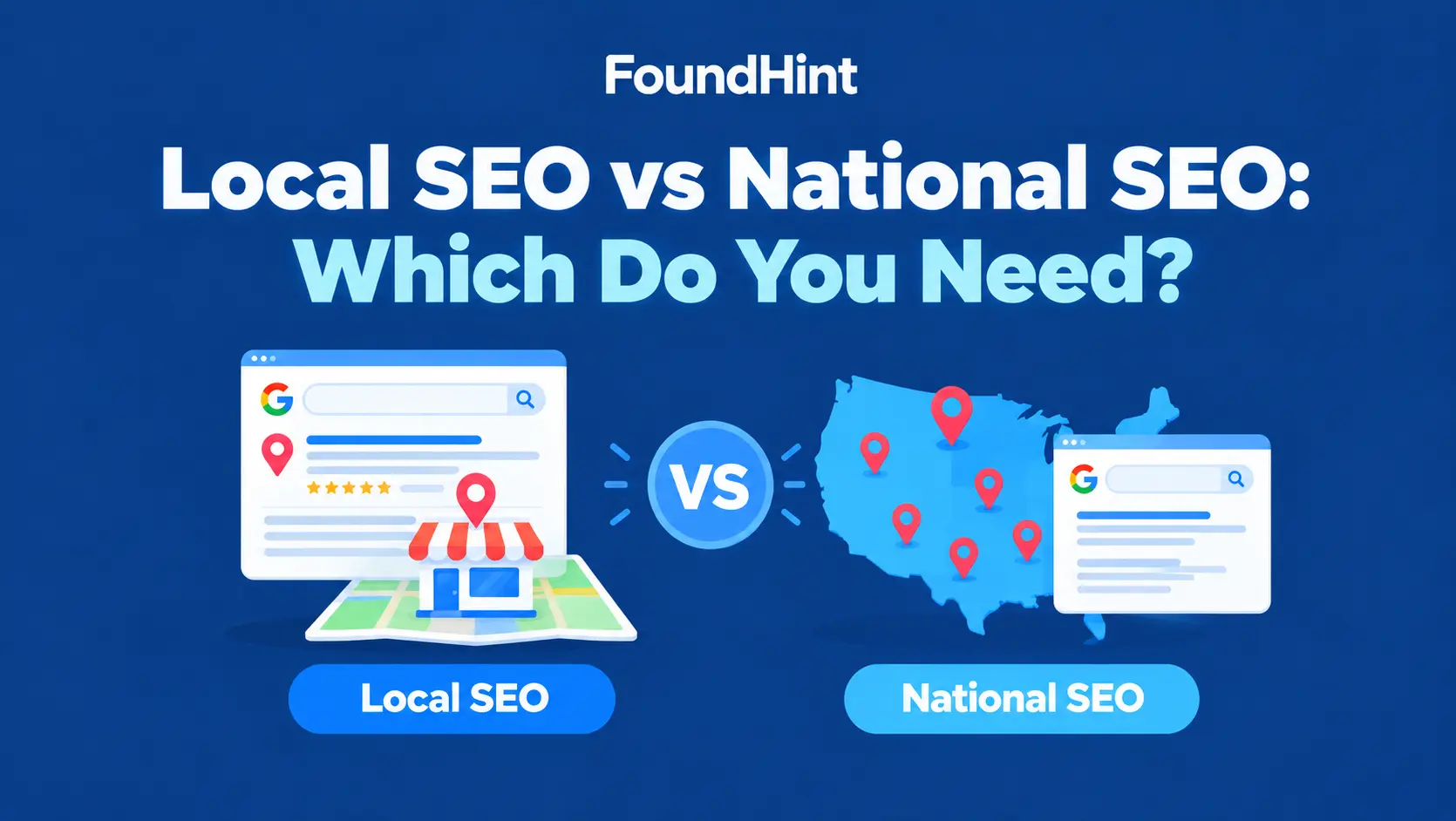
Local SEO vs National SEO at a Glance
If you only have a minute, this table covers the main differences between local and national SEO.
| Factor | Local SEO | National SEO |
|---|---|---|
| Target audience | Customers in a defined city, region, or service area | Customers anywhere in the country |
| Keyword focus | Service plus location searches, like “emergency plumber Denver” or “dentist near me” | Broad searches with no location, like “best CRM software” or “how to fix a leaky faucet” |
| Where you rank | The local pack, Google Maps, and local organic results | Standard organic results nationwide |
| Google Business Profile | Essential for eligible businesses | Usually not central to the strategy |
| Proximity | A major ranking factor | Mostly irrelevant |
| Landing pages | Service pages, location pages, and service-area pages | National service, category, product, and topic pages |
| Link building | Local organizations, chambers, sponsors, and local news | Industry publications and authoritative national websites |
| Reviews and citations | Critical for trust and visibility | Helpful for brand trust, less important for rankings |
| Competition | Other businesses in your area | National brands, publishers, and big ecommerce sites |
| Content | Local services, neighborhoods, and community needs | Broad guides, research, products, and topical expertise |
| Typical cost | Usually lower, because the scope is smaller | Usually higher, because the scope and competition are bigger |
| Main outcomes | Calls, direction requests, bookings, and store visits | Nationwide traffic, leads, signups, and online sales |
What Is Local SEO?
Local SEO is the work of making your business show up when people nearby search for what you offer. When someone types “coffee shop near me” or “roof repair Austin,” Google knows the search has local intent, and it shows results based on where the searcher is. Local SEO helps you win those searches.
If you want the bigger picture, our guide on what local search is and how it works is a good place to start.
How Local Search Results Work
A local search usually shows two kinds of results on the same page:
- The local pack (map pack): the map and three business listings near the top, pulled from Google Business Profiles.
- Local organic results: the regular blue links below, often city pages, service pages, and directory listings.
This matters because you’re really playing two games at once. A business with a strong Business Profile and great reviews can win the map pack even when its website is weaker than a competitor’s.
Google ranks local results mainly on relevance, distance, and prominence, and our breakdown of local SEO ranking factors explains each one.
Google Business Profile and Google Maps Visibility
Your Google Business Profile is the heart of local SEO. It controls what appears in the map pack and on Google Maps: your name, categories, hours, phone, photos, services, and reviews.
A complete, accurate profile is often the fastest win a local business can get.
Location-Based Keywords and Service Pages
Local SEO targets searches that combine a service with a place, like “family dentist Plano TX” or “HVAC repair Phoenix,” plus “near me” searches where the location is implied.
Each core service usually gets its own page, and businesses with several offices or service areas often add location pages with real local information.
Local Citations, Reviews, and Local Backlinks
Three more signals support local rankings:
- Citations: mentions of your business name, address, and phone number on directories and other sites. Keeping them consistent is what NAP consistency is all about.
- Reviews: the number, quality, and freshness of reviews, plus how you reply to them.
- Local backlinks: links from local news sites, chambers of commerce, sponsors, and community groups.
Businesses That Benefit Most From Local SEO
Local SEO is the natural fit for any business whose customers are nearby: restaurants, dentists, plumbers, electricians, law firms, salons, gyms, auto repair shops, real estate agents, and retail stores.
If people visit you, or you drive to them, local SEO usually deserves your first dollar. Not sure if that’s you? Here’s a closer look at why local SEO matters for small businesses.
What Is National SEO?
National SEO is the work of ranking for searches across an entire country, without tying your visibility to one city or region. A software company that wants to rank for “project management software,” or an online store that wants to rank for “organic dog food,” is doing national SEO.
The searcher’s location barely matters. What matters is who has the most useful, trusted page on the topic.
Ranking for Keywords Across a Country
With national SEO, you compete in standard organic results that look roughly the same in Seattle as they do in Miami. There’s no map pack to win and no proximity advantage.
That makes the playing field bigger, and the competition tougher, because you’re up against national brands, big publishers, marketplaces, and well-funded ecommerce sites.
Broad Informational and Commercial Search Terms
National keyword research focuses on two kinds of searches:
- Informational: questions and how-to searches like “how to choose a CRM” or “what is term life insurance.”
- Commercial and transactional: product and comparison searches like “best running shoes for flat feet” or “buy standing desk.”
These terms often have far more search volume than local terms, but also much higher keyword difficulty.
Content Strategy, Topical Authority, and Backlinks
National rankings are usually won through three things working together:
- Content depth: helpful guides, product and category pages, comparisons, and original research.
- Topical authority: covering a subject thoroughly through connected content hubs, so Google sees your site as a go-to source.
- Authority backlinks: links from respected industry publications, national media, and trusted websites.
Technical SEO matters more at this scale too, since national sites tend to be larger, with more pages to crawl, index, and keep fast.
Businesses That Benefit Most From National SEO
National SEO fits businesses that sell or serve customers wherever they are: ecommerce stores that ship nationwide, SaaS and software companies, online course creators, publishers and blogs, national service providers like insurance or financial companies, and remote agencies or consultants.
If your customer’s location doesn’t change whether they can buy from you, national SEO is usually the main focus. For a deeper look at how standard SEO differs from the local kind, see local SEO vs SEO.
Local SEO vs National SEO: Key Differences
The core difference between local vs national SEO comes down to two things: geography and search intent. Local SEO wins nearby customers who are ready to call, visit, or book. National SEO builds visibility and authority with a wider audience.
Here’s how that plays out across ten areas.
1. Target Audience
Local SEO targets people in a specific city, county, metro area, or service radius. National SEO targets anyone in the country who fits your customer profile, no matter where they live.
2. Geographic Reach
A Chicago bakery cares about searchers within a few miles. A coffee subscription brand cares about searchers in all 50 states. Local reach is narrow but deep; national reach is wide but more contested.
3. Keyword Strategy
Local keywords usually include a place or “near me”: “divorce lawyer Atlanta,” “pizza delivery Brooklyn.” National keywords skip the place: “how to file for divorce,” “best frozen pizza.” Local terms have lower search volume but very high buying intent. National terms bring more traffic, but often earlier in the buying journey.
4. Google Business Profile Relevance
For local SEO, a Google Business Profile is essential and often drives more calls than the website itself. For national SEO, it’s usually a minor brand asset. Online-only businesses with no in-person location or service area may not even qualify for one.
5. Website and Landing-Page Structure
Local sites are built around service pages and, where useful, location or service-area pages. National sites are built around category pages, product pages, and topic clusters that cover a subject in depth.
6. Link-Building Approach
Local link building focuses on relevance to your area: chambers of commerce, local sponsorships, community events, nearby business partners, and local news. National link building chases authority: industry publications, national media, research citations, and respected websites in your niche.
7. Competition
Locally, you compete with a handful of businesses in your area. A plumber in Kansas City only needs to beat other Kansas City plumbers. Nationally, you compete with every business targeting the same term, including household-name brands.
8. Content Strategy
Local content answers local needs: neighborhood guides, local project examples, area-specific FAQs, and community news. National content aims for depth and breadth: complete guides, comparisons, original data, and topic hubs.
9. Measurement and Reporting
The two strategies need different scorecards.
| What to track | Local SEO | National SEO |
|---|---|---|
| Visibility | Map pack rankings and rankings by neighborhood | National keyword rankings and share of voice |
| Engagement | Business Profile calls, direction requests, website clicks | Organic sessions, engagement, and returning visitors |
| Conversions | Phone calls, form fills, bookings, store visits | Online sales, signups, demo requests, leads |
| Trust signals | Review count, rating, and reply rate | Branded searches, mentions, and backlinks |
| Tools | Google Business Profile performance, Google Search Console, GA4, local rank grids | Google Search Console, GA4, keyword tracking tools |
10. Business Goals
Local SEO is built for steady, high-intent leads from your own market. National SEO is built for scale, brand awareness, and reaching customers you could never serve in person.
Your goal should decide the strategy, not the other way around.
Local SEO vs National SEO: Which Strategy Is Better?
So, which is best between local SEO vs national SEO? Neither one is better in general. The better strategy is the one that matches where your customers are and how they buy.
Use this quick test: if a customer three states away found you today, could they become a paying customer? If the answer is no, local SEO comes first. If the answer is yes, national SEO deserves a bigger share of your effort.
Choose Local SEO If You Serve a Specific Area
Local SEO is the right primary strategy if:
- Customers visit your location, or you travel to them.
- You serve a defined city, metro, or service radius.
- Most of your leads come by phone, walk-in, or booked appointments.
- You want faster, more predictable results on a smaller budget.
Typical examples: restaurants, plumbers, dentists, law firms, retail stores, salons, HVAC companies, and other local service providers. A dental office in Tampa gains nothing from ranking in Oregon, but ranking in the Tampa map pack can fill its calendar.
Choose National SEO If You Target Customers Nationwide
National SEO is the right primary strategy if:
- You sell online and ship anywhere in the country.
- Your service is delivered remotely, like software, consulting, or online courses.
- Your audience is defined by interest or need, not location.
- You can commit to a longer timeline and bigger content and link investment.
Typical examples: national ecommerce brands, publishers, software companies, and businesses selling services across the country.
Use Both If Your Business Has Local and National Goals
Many businesses don’t fit neatly into one box. A furniture store with a showroom in Charlotte might also sell online nationwide. A regional law firm might want local clients in each office city while publishing legal guides read across the country.
A franchise needs strong local listings for every location and a national brand presence on top.
In these cases, a hybrid strategy works best: location pages and Business Profiles capture local customers, while broader guides and category pages build national visibility.
We cover how to do this without your pages competing against each other in the section on combining local and national SEO below.
Local SEO vs National SEO Strategies
Knowing the difference is one thing. Here’s how local vs national SEO strategies actually change the day-to-day work.
Keyword Research
Local keyword research starts with your services and your cities, then looks for the way real people search: “water heater installation Columbus,” “best brunch in Nashville,” “urgent care near me.”
National keyword research starts with topics and products, then digs into questions, comparisons, and buying terms with no location attached.
The same business can have both types. Look at how a roofing company’s keywords split:
| Search | Intent | Strategy | Best page |
|---|---|---|---|
| roof replacement Dallas | Ready to hire locally | Local | Dallas roof replacement service page |
| roofer near me | Ready to hire nearby | Local | Business Profile and homepage |
| metal roof vs shingles | Researching options | National | In-depth comparison guide |
| how long does a roof last | Early research | National | Informational blog post |
Search intent decides which page should target each keyword. Our guide to local SEO keyword research walks through the full process.
Website Structure
Your site structure should reflect your business model. A local business typically needs a clear homepage, one page per core service, an about page with real local details, and location or service-area pages only where you genuinely serve those areas.
A national business leans on category pages, product pages, and informational content organized into topic hubs. Our article on WordPress site structure for service businesses shows a practical local layout.
Google Business Profile
For eligible local businesses, the Business Profile is often the single most important asset. Keep your categories, hours, services, photos, and contact details accurate, post updates, and reply to reviews.
But a Business Profile is not a substitute for a national organic SEO strategy. It helps you appear in local results, not in nationwide searches for broad topics.
Content Marketing
Local content builds relevance to a place: neighborhood guides, local project case studies, seasonal tips for your climate, and community resources.
National content builds authority on a topic: complete guides, original research, comparisons, and content hubs that answer every related question.
A Denver landscaper writes about drought-tolerant plants for Colorado yards; a national garden brand writes the definitive guide to drought-tolerant plants.
Link Building
Local links come from relationships in your community: chambers of commerce, local sponsorships, nearby business partners, local news coverage, and community events.
National links come from industry publications, trade associations, data-driven content, and respected websites in your niche. Both need relevance; national just needs more authority.
For local tactics, see our guide to local SEO link building.
Reviews and Citations
Business listings and reviews matter far more for local businesses. Consistent local citations and a steady flow of genuine Google reviews support map pack rankings and help customers choose you.
National SEO still benefits from reviews on product pages and trusted review sites, but rankings depend much more on content quality and authority.
Technical SEO
Both strategies need the same foundation: crawlable pages, indexable content, mobile usability, fast load times, sound internal linking, and clean site performance.
Local sites also benefit from accurate LocalBusiness schema, while large national sites need closer attention to crawl budget, duplicate content, and site architecture.
Local SEO vs National SEO for Different Business Types
The right mix depends heavily on your industry. Here’s how the decision usually plays out.
Small Businesses
For most small businesses serving nearby customers, local SEO vs national SEO isn’t a close call. Local SEO comes first. It’s more affordable, the competition is smaller, and the leads are closer to buying.
A neighborhood bakery in Portland will get far more from a complete Business Profile and steady reviews than from chasing “best sourdough recipe” nationwide.
A small business can still use national SEO later, especially if it starts selling online.
Real Estate Agents
Real estate is local by nature. Buyers search for agents and homes in specific cities and neighborhoods, so local SEO should lead: a strong Business Profile, neighborhood pages with genuine insight (schools, commute times, price trends), and listing content for your market.
National real estate topics like “how to buy your first home” are dominated by big portals, so treat them as supporting content that builds trust, not your main ranking target.
Dental Offices and Private Clinics
When comparing local SEO vs national SEO for dental office marketing, local wins almost every time. Patients search for dentists close to home or work. Focus on accurate business information, the right categories, pages for each treatment you offer, and genuine patient reviews.
Because this is healthcare, your content also needs to be accurate and trustworthy, ideally reviewed by a qualified professional. National content about dental topics can help build authority, but it shouldn’t come before your local foundation.
Law Firms
Law firms are a classic hybrid case. Clients usually want a lawyer licensed and located near them, so city-specific practice pages and a strong Business Profile for each office drive the most valuable cases.
At the same time, legal questions like “what to do after a car accident” are searched nationwide, and good answers build authority and trust.
A personal injury firm in Houston might target “car accident lawyer Houston” locally while publishing broader legal guides. Firms with offices in several states can scale this with a multi-location local SEO approach.
Service Businesses
Plumbers, electricians, HVAC companies, cleaners, and contractors should focus on local SEO for service businesses: service pages for each job type, pages for the areas you actually serve, and a Business Profile set up correctly for your eligibility.
If you travel to customers and don’t serve them at your address, set up your profile as a service-area business and hide your address.
Our guide to service area business SEO explains how.
Online Businesses
For online businesses with no physical location customers visit and no service area, national SEO is usually the right fit. Focus on keyword research, product and category pages, helpful content, and authority links.
Keep in mind that businesses without an eligible in-person location or service area may not qualify for a Google Business Profile at all.
If you also have a local warehouse pickup or a showroom, a hybrid approach may make sense, and online stores on WordPress can see how this works in our guide to WooCommerce local SEO.
Franchises and Multi-Location Brands
Franchises need both. Each location needs its own accurate Business Profile, consistent listings, and a useful location page, while the brand builds national visibility through content and authority.
Our guide to franchise local SEO covers how to balance brand control with local flexibility.
Local SEO vs National SEO: Cost and Competition
Is national SEO more expensive than local SEO? Usually, yes, but not because of a fixed price tag. Costs grow with scope and competition. Instead of quoting numbers that change by market and provider, here are the factors that actually drive your budget.
Factors That Affect SEO Budgets
- Your industry: competitive fields like law, insurance, and home services cost more in either strategy.
- Your market size: ranking a dentist in a small town takes far less than ranking one in Los Angeles.
- Your starting point: an established site with links and reviews needs less work than a brand-new one.
- Who does the work: doing it yourself, hiring a freelancer, or hiring an agency changes the cost a lot.
Geographic Scope and Number of Target Pages
Local SEO usually covers one area and a manageable set of service pages. National SEO often needs dozens or hundreds of category, product, and content pages to compete. Multi-location businesses sit in between: each new location adds a Business Profile, listings, and a location page to maintain.
Competition and Content Requirements
Locally, you might need to beat five or ten competitors, many of whom haven’t done much SEO. Nationally, you’re up against brands with dedicated content teams. That means more content, more depth, and higher quality to earn a spot on page one.
Link Acquisition and Ongoing Maintenance
Local links often come from relationships you already have, like sponsorships, suppliers, and local groups. National links usually require outreach, digital PR, or original research, which takes more time and money. Both strategies need ongoing upkeep: refreshing content, managing reviews, fixing technical issues, and responding to algorithm changes.
Timelines: What to Expect
Local SEO often shows earlier wins, because fixing a Business Profile or earning reviews can move map rankings in weeks, while bigger gains take a few months. National SEO usually takes longer, often many months, because building content and authority in a crowded space is slow work. Treat these as general expectations, not promises; your market and starting point matter more than any average.
How to Prioritize Resources Based on Business Goals
Put most of your budget where most of your revenue comes from. Use this as a starting point, not a rule:
| Your business | Where to focus first | What to add later |
|---|---|---|
| Single-location local business | Business Profile, service pages, reviews, citations | Helpful local content and local links |
| Multi-location or franchise | A strong local setup for every location | Brand-level content and national links |
| Local business that also sells online | Local foundation first | Product, category, and national content |
| Online-only or nationwide business | Keyword research, content, technical SEO, authority links | Local pages only if you add physical locations |
How to Choose the Right SEO Strategy
Still on the fence? Work through these seven steps and the right answer usually becomes obvious.
Step 1: Define Your Target Customers
Write down who buys from you and where they are. Look at your last 50 customers or orders. If nearly all of them live within 30 miles, you’re a local business, whatever your ambitions. If they’re spread across many states, national SEO matters.
Step 2: Identify Where Your Customers Search
Think about how your customers find businesses like yours. Do they open Google Maps and tap “call”? Do they type a question and read guides before buying? Local searchers want a nearby business now; national searchers often research first.
Step 3: Research Local and National Keywords
List your services and products, then check search volume and difficulty for both versions: with a city (“bathroom remodel San Diego”) and without (“bathroom remodel ideas”). This shows where real demand exists and how hard each term will be to win.
Step 4: Review Your Competitors
Search your main keywords and look at who ranks. If the local pack is full of small competitors with thin profiles, local SEO is a big opportunity. If page one for a national term is all household brands and major publishers, that keyword is a long-term goal, not a quick win.
Step 5: Map Keywords to Relevant Pages
Give every important keyword one clear page. Local terms go to service and location pages; national terms go to guides, category pages, and product pages. This keeps pages focused and stops them from competing with each other.
Step 6: Set Measurable Goals
Decide what success looks like before you start. For local SEO, that might be more calls, direction requests, or bookings from your Business Profile. For national SEO, it might be organic traffic, signups, or online sales. Tie each goal to a number you can track in Search Console, GA4, or your Business Profile performance report.
Step 7: Review Results and Adjust
Check progress every month and review strategy every quarter. If local efforts are maxed out and you’re winning your market, it may be time to add national content. If national work isn’t paying off, shift budget back to what drives revenue.
Can You Combine Local SEO and National SEO?
Yes, and for many businesses it’s the smartest approach. The key is giving each strategy its own job and its own pages, so they support each other instead of competing.
How a Hybrid Strategy Works
Think of it in two layers:
- The local layer: an accurate Business Profile for each eligible location, consistent listings, reviews, and service or location pages built for “service + city” searches.
- The national layer: broader guides, category pages, and topic content that answers questions people ask everywhere, plus links from industry sites.
The layers feed each other. National content earns links and authority that lift the whole domain, including your local pages. Local pages turn that visibility into calls and visits.
A Simple Hybrid Site Structure
Here’s how a home services company with offices in Phoenix and Tucson might organize its site:
| Page | Targets | Layer |
|---|---|---|
| /ac-repair/phoenix/ | “AC repair Phoenix” | Local |
| /ac-repair/tucson/ | “AC repair Tucson” | Local |
| /blog/why-is-my-ac-blowing-warm-air/ | “AC blowing warm air” | National |
| /blog/ac-repair-vs-replacement/ | “repair or replace AC” | National |
Each page has one clear job, and the national guides link to the right local service pages when readers are ready to hire.
Avoid Keyword Cannibalization
Keyword cannibalization happens when two of your pages target the same search, so Google isn’t sure which one to rank and both may underperform. To avoid it:
- Assign one primary keyword and intent to each page.
- Don’t write a national blog post that targets the same “service + city” term as your location page.
- Link from broad content to specific local pages with clear anchor text.
- Check Search Console for queries where two of your pages trade places, then merge or refocus them.
Keep each page focused on a distinct search intent, and the two strategies will work together instead of against each other.
Local SEO vs National SEO Checklist
Use this checklist to set up the right strategy and keep it on track.
- Define your geographic target: one city, several areas, or the whole country
- Identify your primary customer segments and where they live
- Research location-based and nationwide keywords
- Review competitors in both the local pack and national organic results
- Build appropriate service, location, or category pages
- Optimize eligible Google Business Profiles
- Keep your business name, address, and phone consistent across listings
- Develop relevant content and earn backlinks that fit your strategy
- Give each page one keyword and intent to avoid cannibalization
- Set up conversion and organic traffic tracking
- Review results regularly and adjust your mix
Want a broader setup list for your site? Our WordPress local SEO checklist covers every step.
How FoundHint Plugin Helps With the Local Side of Your SEO?
If local SEO is your main focus, or the local layer of a hybrid strategy, FoundHint makes the work easier from inside WordPress.
It’s a local SEO plugin that connects your Google Business Profile to WordPress in a few clicks, with no API keys or Google Cloud setup.
Here’s what it helps you manage:
| Local SEO task | How FoundHint helps |
|---|---|
| Accurate business information | Edit your business info, address, hours, special hours, social links, attributes, and services, then send updates to Google |
| Multiple locations | Manage every Google Business Profile location from one WordPress dashboard |
| Reviews | See and reply to reviews, and set up personalized auto-replies |
| Fresh profile activity | Create and schedule Business Profile posts, and add or remove photos |
| Products and services | Sync WooCommerce products and add your services to your profile |
| Local rankings | Use the Ranking Grid to see where you rank on the map for your target keywords and locations |
| Citations | Find directories based on your business category, see where you’re listed and where you’re missing, and decide where to list your business |
To be clear about the difference: FoundHint supports local optimization. National SEO still needs a broader plan with in-depth content, technical SEO, and authority-building links. For businesses running both, FoundHint takes care of the local work so you have more time for the national side.
Frequently Asked Questions
What is the difference between local SEO and national SEO?
Local SEO helps a business rank for searches in a specific area, mainly through the map pack, Google Maps, and local organic results. National SEO helps a business rank for broader searches across a whole country through standard organic results. Local relies heavily on a Business Profile, reviews, and proximity; national relies on content depth, topical authority, and authoritative links.
Is local SEO better than national SEO?
Neither is better overall. Local SEO is better for businesses that serve customers in a specific area. National SEO is better for businesses that sell or serve customers anywhere in the country. Many businesses benefit from a mix of both.
Can a small business use national SEO?
Yes, if it sells online or serves customers remotely. But most small businesses with local customers get faster, more affordable results by starting with local SEO, then adding national content once the local foundation is strong.
Can a business use local and national SEO together?
Yes. Use location pages and Business Profiles for local searches, and broader guides and category pages for national searches. Give each page a distinct keyword and intent so your pages don’t compete with each other.
Is national SEO more expensive than local SEO?
Usually, yes. National SEO covers more keywords, more pages, and tougher competition, and it typically needs more content and link building. Actual costs depend on your industry, market, starting point, and who does the work.
Which keywords should a local business target?
Focus on searches that combine your services with your location, like “emergency electrician Charlotte,” plus “near me” searches and service-specific terms. Map each keyword to the most relevant service or location page.
Does national SEO require a Google Business Profile?
No. A Business Profile is built for businesses with an in-person location or service area. National SEO focuses on organic rankings, which depend on your website, content, and links. Online-only businesses may not be eligible for a Business Profile at all.
How do I choose between a local SEO agency and a national SEO agency?
When deciding local SEO agency vs national agency, which is better depends on your goal. Pick a local SEO specialist if most of your revenue comes from nearby customers; they’ll know Business Profiles, citations, reviews, and map rankings well. Pick an agency with national experience if you sell nationwide; look for strengths in content strategy, technical SEO, and digital PR. Hybrid businesses should ask any agency to show results in both areas.
How long does local SEO take compared to national SEO?
Local SEO often shows earlier wins, sometimes within weeks for Business Profile fixes, with bigger gains over a few months. National SEO usually takes longer because building content and authority in a competitive space is gradual. Your market and starting point affect both timelines.
What about global or international SEO?
Global SEO targets audiences in several countries or languages. It adds work like translated content, country-specific pages, and hreflang tags. If you only sell within the US, you only need to think about local and national SEO.
Conclusion
The local SEO vs national SEO decision comes down to one question: where are your customers, and how do they search? Choose local SEO when nearby customers and geographic relevance are central to your business.
Prioritize national SEO when your audience spans the country and location doesn’t affect who can buy. Combine both when your business model supports local and national goals, with each page focused on its own search intent.
Whatever you choose, base your strategy on customer intent and measurable results like calls, bookings, signups, and sales, not just rankings. Start with the strategy that drives the most revenue today, build it well, and expand when you’re ready.
If you’re building your local foundation from scratch, our guide to building a WordPress website for a local business is a great next step.